By Eric Hill
Director of Technical Operations
Digital dentistry isn’t new. Sirona brought the first intraoral scanner to market in (gulp) 1987 with Cerec 1, and things started taking hold in 1994 with Cerec 2. So the real divide today isn’t between practices that are digital and those that aren’t. It’s between practices that have built effective digital workflows and those that are still figuring it out... 40 years later.
Plenty of offices own intraoral scanners. Far fewer are using them in a way that consistently improves outcomes, reduces friction, and drives growth. That’s not a technology problem. That’s a workflow and training problem. Intraoral scanning (IOS) is often framed as a better way to take impressions.
While that's technically true, it's strategically incomplete. The real value of IOS becomes clear when it is used as the backbone of practice operations, how cases are diagnosed, communicated, and executed from start to finish. When that happens, you start to see meaningful shifts:
Clinical outcomes become more predictable because the data going to the lab is cleaner and more complete. Chair time drops because fewer cases need to be redone. Patients engage more because they can actually see what’s happening. And case acceptance improves because the conversation becomes clearer and more visual.
But none of that happens automatically. If your team is scanning inconsistently, skipping review and built-in QC tools, or treating digital impressions the same way they treated analog ones, you’re not running a digital workflow. You’re just using digital tools.
Where Most Intraoral Scanning Implementations Break Down
Most failures in intraoral scanning don’t come from the scanner itself. They come from a lack of training and discipline in how it's used.
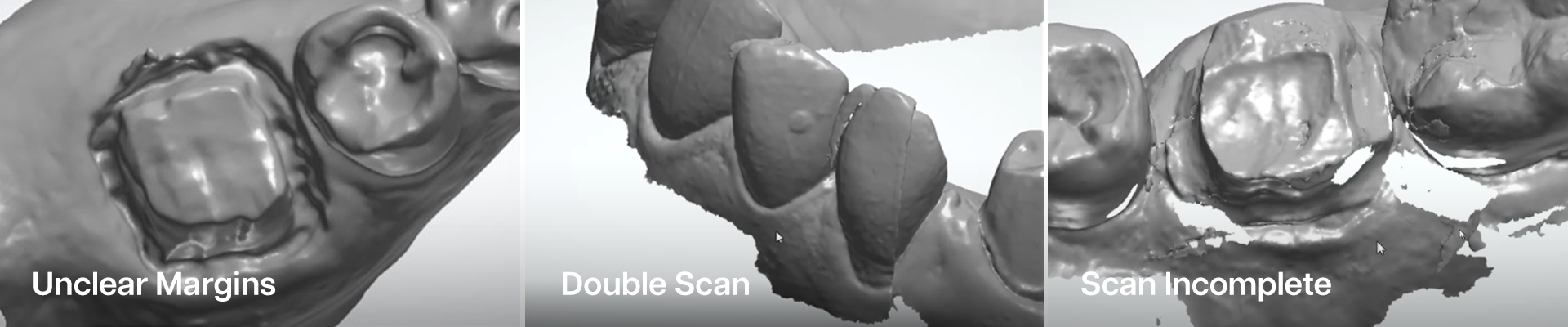
Common scan issues
Take margin capture, for example: In a traditional impression, material can compensate, at least partially, for poor tissue management by mechanically displacing the tissue around the margin. Digital doesn’t give you that margin for error (pun intended). If the tissue isn’t controlled via cord packing, laser, etc., and the margin isn’t clearly visible, the scan is compromised, and there’s no failproof workaround downstream at the lab, although many labs have gotten very good at guessing.
The same goes for scan strategy. Without a consistent approach to how scans are captured, you introduce variability between operators, which leads to inconsistent results. One assistant captures clean, usable data. Another introduces distortion without realizing it. The lab gets both, and now predictability is gone.
And then there’s the simplest and most common miss of all: not reviewing scans before submission.
This is where most practices quietly lose efficiency (and money). They capture the scan, send it, and move on, only to deal with a remake later. High-performing teams treat scan review as a non-negotiable step. They catch problems immediately, when they’re easy to fix, instead of days later when they’re expensive. Nobody wants to call a patient back to the chair, remove temps, and rescan when it could have been caught with available tools during scanning.
Accuracy in digital dentistry isn’t about having the right device; devices are all technically accurate enough to provide good results. It’s about having the right system to fit your workflows, as well as excellent training from your vendor or lab. I cannot stress that last part enough. Proper training will reduce chair time, remakes, and headaches down the road. If you wing it, you are just losing time and money.
The practices that succeed don’t start by trying to do everything. They start by doing the right cases for their level of expertise and adding new processes as their expertise grows. Start small.

Utilizing IOS for clear aligners.
Clear Aligners
Clear aligner therapy is often positioned as an easy add-on, and it absolutely can be, but it also requires diligence and proper training.
IOS removes a significant amount of friction when submitting for clear aligners. Case submission is faster, visualization is better, and communication becomes more streamlined. I will add that I do not recommend scanning models from traditional impressions for clear aligner submissions. Can it be done? Sure, but more often than not, the model scan has glaring issues, and the cases can get rejected. IOS is the very clear winner here (the puns just write themselves!).
Early success typically comes from choosing the proper patients... minor crowding, minimal bite issues, etc. These cases allow the team to learn the system, refine communication, and build confidence without introducing unnecessary complexity.
Once the workflow is stable, growing your patient pool becomes much easier, and the cases become slam dunks with minimal involvement.
The Most Undervalued and Underleveraged Piece of the Digital Dentistry Puzzle: Your Lab Partner
There's a common assumption that digital dentistry reduces dependence on the lab. In reality, it does the opposite.
When everything becomes digital, the quality of the data and how it's interpreted matters more than ever. That's where the lab shifts from vendor to operator within your workflow.
A strong lab partner doesn't just fabricate "parts." They identify issues early, flag unclear margins, help standardize submissions, and improve the consistency of outcomes over time. If that feedback loop isn't there, problems don't disappear. They just show up later as remakes, delays, and frustration.
This is where many practices may miscalculate. They invest in digital tools but don’t elevate the relationship with their lab, which, in most cases, has been dealing with digital dentistry since its inception. They are experts. The result is a disconnected workflow where each side operates independently, and because of that, efficiency suffers, and time that should be gained is lost.
If your lab is simply fulfilling orders, they’re not supporting your digital transition. In fact, they are limiting it!
Why Digital Workflows Change the Case Acceptance Conversation
Most practices think of IOS as a clinical tool, and it is, but one of its biggest strengths is communication lubrication. Everything can be much more seamless when used properly.
When a patient can see a real-time 3D model of their dentition, the conversation changes. You’re no longer explaining something abstract; you're showing something tangible.
Patients don't necessarily reject treatment because they don't want it. They may reject it because they don't fully understand it or simply don't trust the recommendation. Visualization closes those gaps. But this only works if it's used intentionally. If scanning happens in isolation without integrating it into the patient conversation, you’re leaving one of its biggest advantages on the table. Scanning can sell cases.
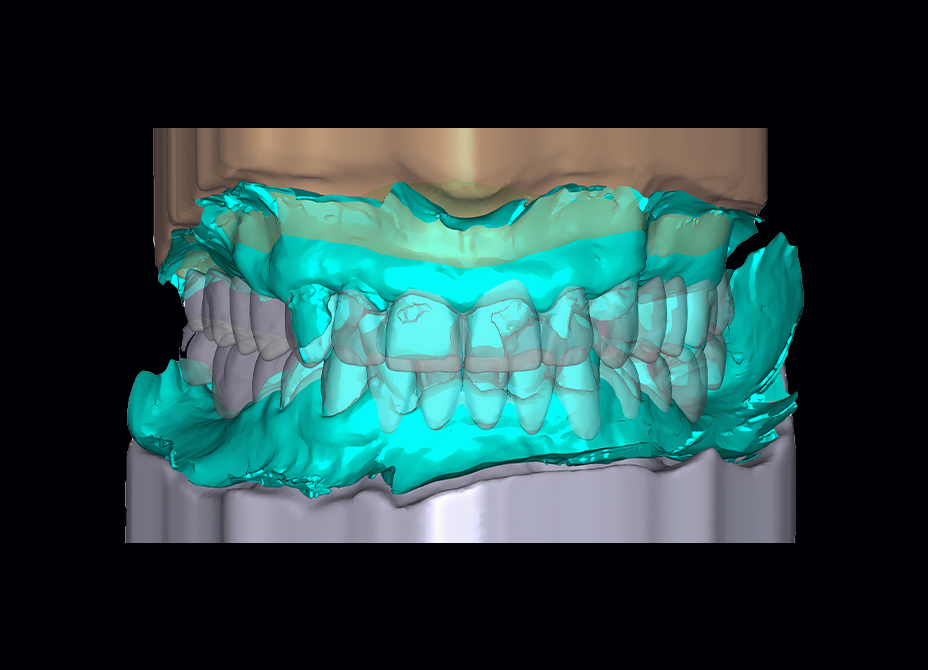
Example of patient’s dentition overlayed with proposed design
Scaling Digital Dentistry Requires Systems, Not Effort
If every scan depends on who's holding the wand, you don't have a scalable workflow. If submission protocols vary by case or by team member, you don't have consistency. If aligner cases are handled ad hoc instead of through a defined process, you don't have efficiency. High-performing practices remove that variability. They define how scans are taken, how they're reviewed, how cases are submitted, and how follow-ups are managed. Everyone operates from the same playbook.
That's what turns digital dentistry from a tool into an advantage that can grow a practice while also making it significantly more efficient.
The Real Opportunity
At this point, access to technology isn't the differentiator. Most practices can acquire an intraoral scanner. Many already have one. What's rare is execution and purposeful workflow improvements over time.
When intraoral scanning, clear aligner integration, and lab collaboration are aligned under a consistent workflow, the impact compounds quickly.
Fewer remakes.
Shorter turnaround times.
Higher case acceptance.
Expanded treatment offerings.
Better patient experiences.
...Not because of the technology itself, but because of how it's used.
Final Thoughts
The gap in dentistry today isn’t between analog and digital. It’s between practices that have built intentional, optimized digital workflows, and those that are still operating without one or at a basic level.
Technology is available to everyone. So is diligent and purposeful execution. That is where the real competitive advantage lives.
About the Author
Eric Hill
Eric has extensive experience with all major IOS platforms, various milling machines, 3D Printing systems, & several CAM software companies.
Eric has not only consulted for numerous manufacturers and experts in the field, but has also reviewed over 100k scans and helped hundreds of doctors refine their digital dentistry skills.